The Dallington History website is registered with the Society for One-Place Studies, who encourage sharing of OP studies through conferences and seminars. They also offer monthly prompts to write a short or long blog post on a given theme. I haven’t taken up the challenge until now, being busy with other things, but the theme for July is Elections. I’d already started to look at Electoral Registers for Dallington. and found that 200 years ago, only nine people were entitled to vote; that number grew only slowly during the 19th century. So I decided it was time to dig deeper….
General historical background
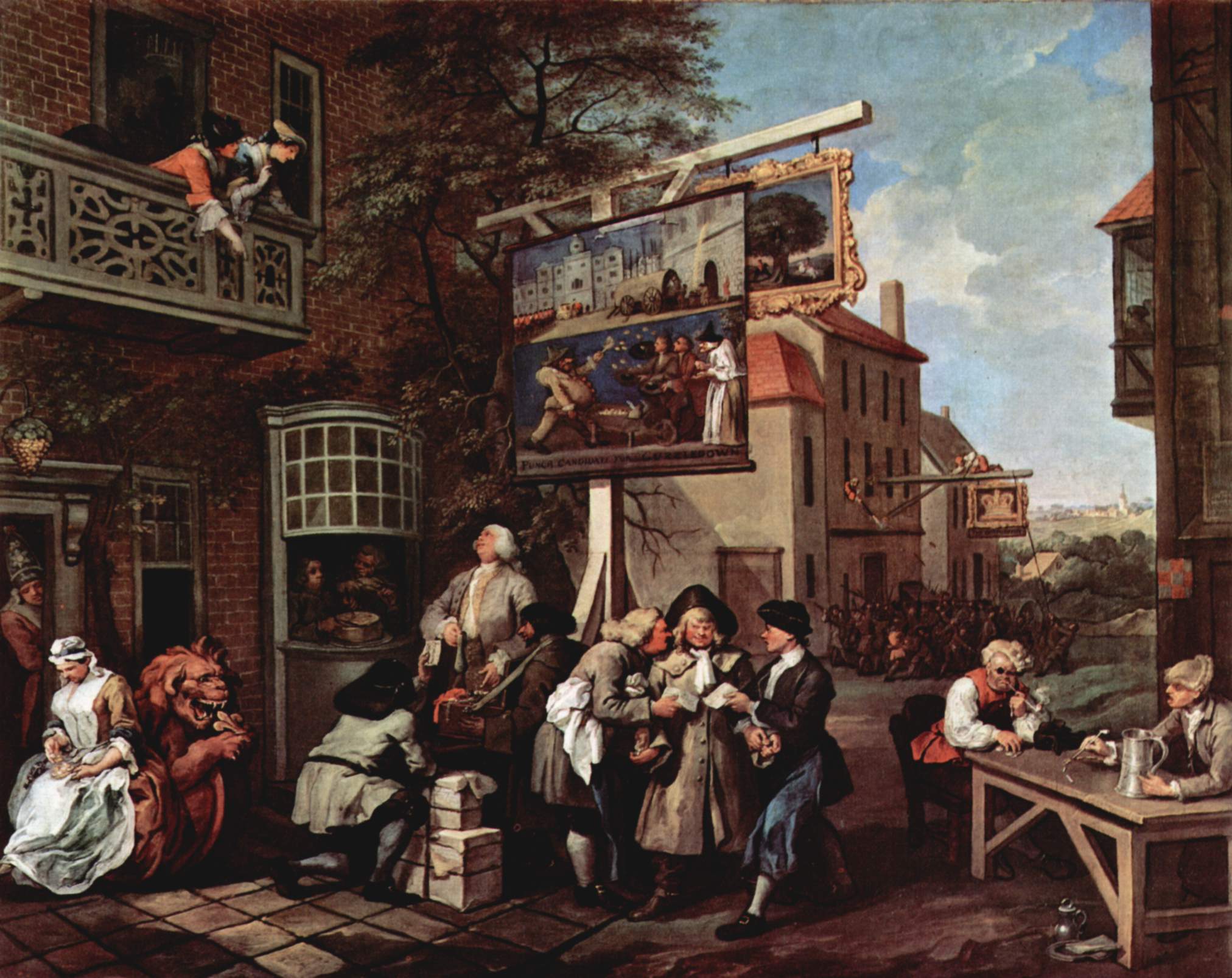
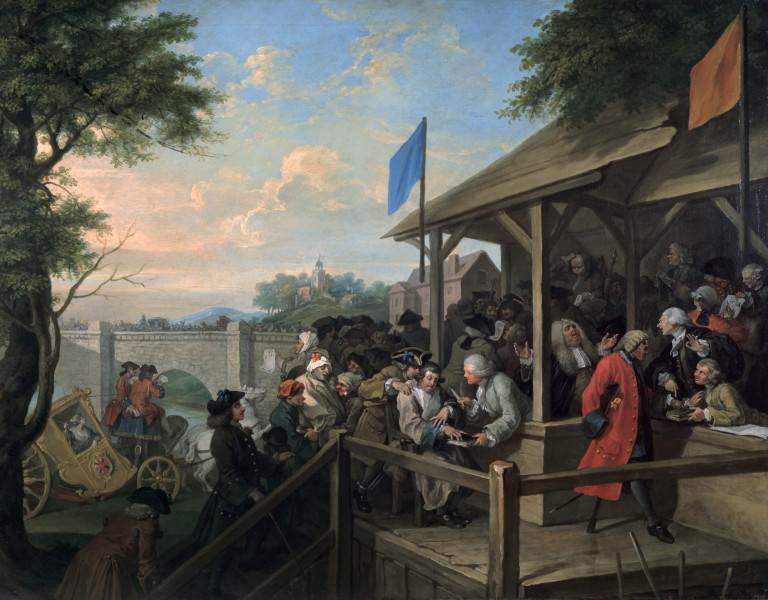
William Hogarth Canvassing for Votes & The Polling from The Humours of an Election series 1755 Photo: © Sir John Soane’s Museum, London
According to the House of Commons Library “History of the Parliamentary Franchise”, the voting system stayed largely unchanged between medieval times and the Great Reform Act of 1832. From 1290 representatives of the English counties were regularly summoned by writ to serve in Parliament, and at first “every free inhabitant householder, freeholder and non-freeholder” was entitled to vote in English county elections. However, after 1430 leaseholders were excluded and the county franchise was restricted to freeholders of a property worth 40 shillings (two pounds); less than 1.5% of population across England were eligible to vote. The 40 shilling requirement remained until 1832. (Interestingly, ancient voting rights in England did not explicitly prohibit women but little is known about how single women or widows who met the property qualification were treated in practice.)
Until 1690 Parliament was a meeting of the chief nobility and representatives of each county (and selected towns or boroughs) that occurred irregularly and for comparatively short periods. Later, Parliament became a permanent institution; each Parliament met for the first time following a general election and was only usually dissolved after several years. Every county returned MPs but uncontested elections were common and in some seats no elections might take place for many years. Parliamentary seats often remained in the control of a family from one generation to the next.
The rest of this post will focus on Dallington, but for some detailed and fascinating accounts of electioneering in Sussex between 1386 and 1832, including lists of MPs at each period, see the articles from the History of Parliament Online website
How did the system work in practice for Dallington voters?
Those Dallington residents who were qualified to vote in the County Elections for Sussex had to travel to the single polling centre – usually Lewes or Chichester, depending on where the county court was taking place – and prove their eligibility to vote. We don’t know how they got there, but most historians estimate travel times, whether on foot, horseback, horse drawn cart or stagecoach, required between several hours and at least a day for the 20 miles to Lewes, and much more than twice that for Chichester (60 miles). So when polls were held in Chichester, it was expensive and inconvenient for voters in the eastern parishes. Agents reported the reluctance of some voters to travel in stage coaches, and a shortage of saddle horses, which led candidates to offer voters incentives in the form of food and travel if not actual monetary bribes.
Hogarth’s 1755 series The Humours of an Election satirises some of these corrupt practices. Even seventy years later, one candidate was apparently ‘quite beside himself during the election’ which lasted nine days – even the freeholders who came to vote for him: ‘all make me pay, none have the zeal to come of themselves, even the clergy must be treated’.
Until secret ballots were introduced in 1872, voters cast their ballot in public – at booths such as those shown in Hogarth’s painting above right – and this was recorded in the published Poll Book. This system lent itself to bribery or intimidation, but also allowed unqualified citizens the chance to come along and watch, or even influence how their wealthier neighbours cast their ballot. And of course the benefit for local historians is that we can see how our Dallington predecessors actually voted.
The 1705 Election The earliest Sussex Poll Book that I have found online is for the 1705 election in the reign of Queen Anne. Sussex returned two MPs at this period and it was common practice to return one Member from West and one from East Sussex, normally from one of the principal families in each division. East Sussex had supported Parliament in the Civil War whereas the west was predominantly royalist, so the Member from West Sussex was usually a court supporter, while the east of the county tended to align with the country party.
Political parties as we know them were not yet fully established, but Tories (originally a derisive term for supporters of the Catholic James II and his heirs) were associated with the established Anglican church and the interests of landed gentry, while the Whigs were more aligned to commercial interests and Protestant dissenters.
In 1705 the poll was taken at Lewes, where polling took place in the old town hall and in four wagons, and the candidates were Sir Henry Peachey, a Whig, and Henry Lumley, a moderate Tory, both from the west, and from the east, Sir George Parker, a Tory and John Morley Trevor, a Whig.
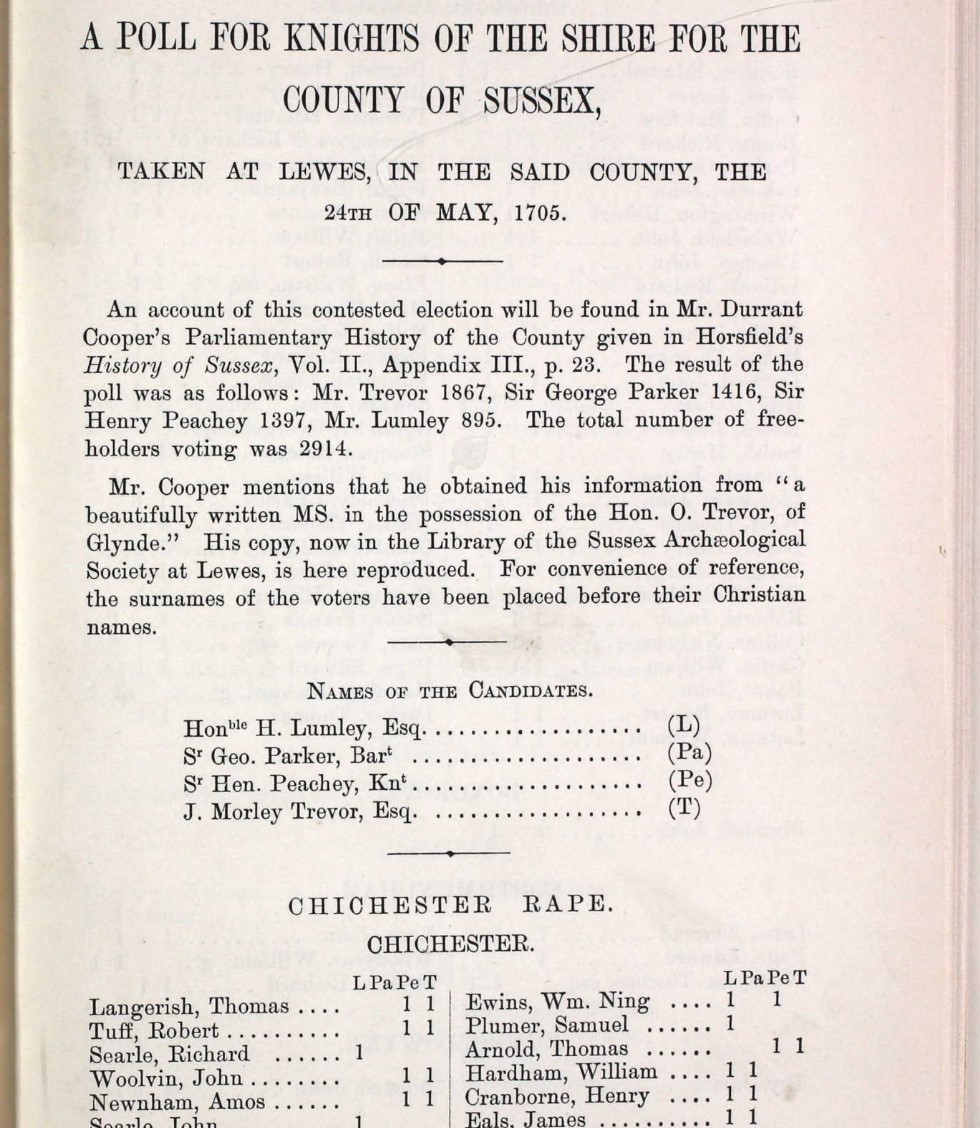
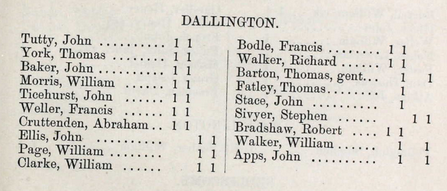
Nineteen Dallington electors cast their votes, most for the two Tories, Lumley and Parker (columns 1 and 2 in the extract shown here), and four for the Whigs Peachey and Trevor, while a few voted across parties choosing the two more local candidates. Trevor and Parker were duly elected. Two more elections took place in 1708 and 1710 but the next for which I have Poll Book evidence is from 1713, the last year of Queen Anne’s reign.
The 1713 election was once again held at Lewes. The Tories put up Henry Campion from Kent and John Fuller of Brightling in East Sussex (the great uncle of our more famous ‘Mad Jack’ Fuller who served as an MP some years later) . The two Whig candidates were John Morley Trevor again, from the east, and James Butler from the west, previously MP for Arundel. Trevor and Butler advertised their joint candidature in the newspapers, soliciting votes as ‘men zealously affected to the present constitution both in church and state, the Queen and Protestant succession in the illustrious House of Hanover, and for the encouragement of the woollen manufactures and all trades advantageous to Great Britain.‘ Campion, on the other hand, they advised, had voted for the treaty of commerce with France in the previous Parliament. In spite of this, the two Tories, Campion and Fuller, won the election.
The 1713 poll book is not shown here, but Dallington voters were recorded as Joseph Weller, John Baldock, Francis Bodle, John Ashby, John Madgwick, William Weller, Samuell Yorkton, John Tutt, Thomas Fatley, Richard Thornton, Thomas Madgewick and Thomas Barton, all of whom voted Tory, with just Nehemiah Panton and John Ticehurst voting Trevor and Butler.
But a year later, after George I succeeded Queen Anne and arrived in London, he dismissed the Tory cabinet and replaced it with one almost entirely composed of Whigs, as they were responsible for securing his succession. The subsequent general election of 1715 saw the Whigs win an overwhelming majority in the House of Commons, and they dominated government for almost the next 50 years.
Sussex reflected this trend, largely due to the influence of the Duke of Newcastle, because of the patronage he could dispense as a member of the Government and his lavish personal expenditure, giving ‘small beer and doles of wheat to all the people of the country about them, without stint or limitation, and of entertaining all comers and goers, with their servants and horses’, at a cost of £2,000 a year. At the 1715 general election he authorized his agent ‘to give five guineas a man’, and the gain of both seats by the Whigs was generally attributed to ‘all manner of indirect practices, particularly by [Newcastle], their grand patron’
For nearly twenty years there were no more contests in Sussex, one of the seats being held by Newcastle’s brother, Henry Pelham, representing the eastern division of Sussex, the other by James Butler, representing the western division.
But in 1734, the anti-government party, hoping to profit by the unpopularity of the excise bill, put up an opposition Whig, Sir Cecil Bishopp, with a Tory, John Fuller ( great uncle to Mad Jack), against the two sitting members.
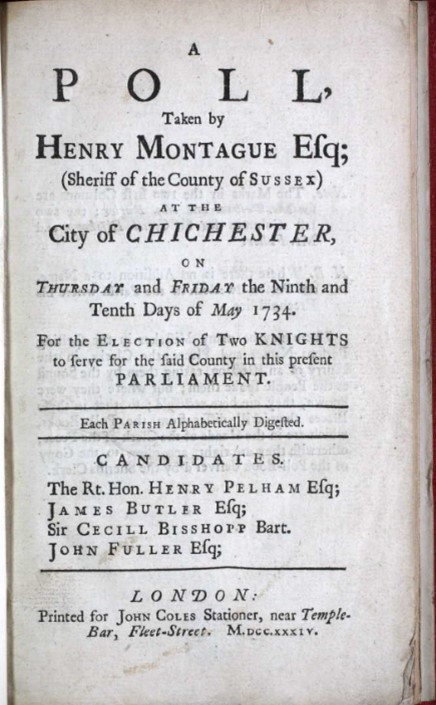
Pelham wrote to Newcastle:
‘We shall carry it, I verily believe, by a great majority, but it is more uphill work than ever I expected to see in this county. The whole county about is poisoned, very little regard in the common people for the King or royal family, less for the ministry, in short it is personal interest must carry this election, nothing else will or can.’
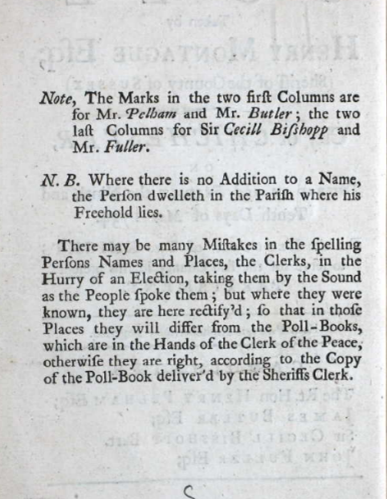
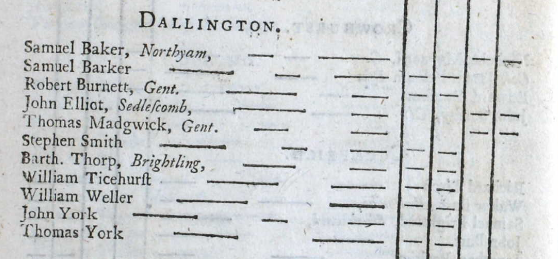
The Dallington section of the Poll Book shows who could vote (placenames in italics refer to land owned outside Dallington) and how they voted. Three men, Samuel Baker, John Elliott and Thomas Madgwick, voted for the two ‘opposition’ candidates, but the others (Samuel Barker, Robert Burnett, Stephen Smith, Bartholomew Thorp, William Ticehurst, William Weller, John York and Thomas York) voted for Newcastle’s preferred candidates, who were duly elected. We do not know whether they did so from conviction or ‘personal interest’.
Pelham and Butler kept their seats unopposed for several years, only replaced after Butler’s death by his son John. Indeed during the Duke of Newcastle’s lifetime (d 1768) one Member was always a Pelham and the other usually a country gentleman friendly to the Pelhams.
It was forty years before the next contested election took place in 1774
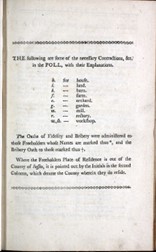
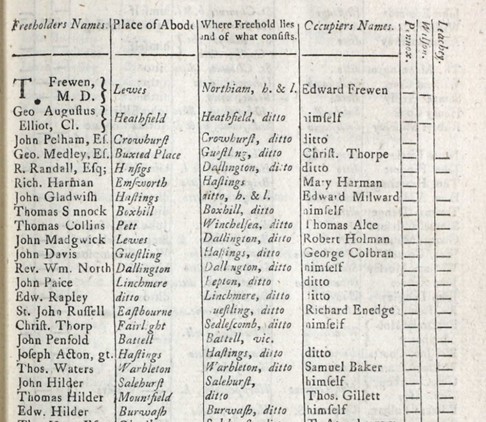
In order to replace an unpopular sitting MP, Richard Harcourt, a meeting of Sussex freeholders adopted Sir Thomas Spencer Wilson as candidate in spite of his reluctance and declaration that ‘he would not be at any expense, either in carrying, supporting, or ornamenting any voter, or on any other account, except the legal expenses of the poll’. The freeholders ‘entered into voluntary subscriptions for the support of their cause’ and the poll lasted twenty-four days. Wilson’s expenses amounted to only £720, and his notes showed his contempt for the whole process:
- For other fools at Uckfield… . £1 1s. od.
- To some fools, dressed in white, with blue ribbons, who ran before my horses into Findon, and some old women there: £1 18s. 6d.
- To some hallowing fools at Rottindean: £1 1s. od.
He later wrote: ‘I never had the least intent to offer myself as a candidate, having a hearty contempt for the House of Commons, which is at present not much abated.‘
Frustratingly, the 1774 Poll Book lists electors not by parish but in apparently random order within each Rape (subdivision of the county) making it harder to find our Dallington voters. It seems only three voters actually lived in Dallington, while another eight lived elsewhere but held freehold property in the village. Perhaps sensibly, given Wilson’s attitude, all seem to have voted for Lennox and Peachey but it was Lennox and Wilson who succeeded.
The next few years saw Lennox and another Pelham as MPs, and then in 1801 ‘Mad Jack’ Fuller replaced Pelham unopposed as a county Member.
If I can find the poll books to take us up to the Great Reform Act of 1832, I will add the information here. Part 2 of this very long post will deal with the changes in electoral processes after that, and how they affected Dallington residents.
 Dallington History