The remains of the two storey octagonal base of Dallington Smock Mill can still be seen in the field next to the Primary School.
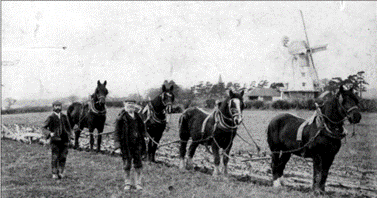
It was a smock mill, ie only the cap and sails revolved. It was octagonal in shape and made of wood, painted white, on a two-storey brick base. You can see it in the background of this photograph taken c1900. The man in the foreground is ‘Happy Jack’ Gadd.
Its history is described in these extracts from Karen Bryant Mole’s book Six Miles from Everywhere p56ff (full text on Resources page):
“In the 1850s, William Clark and Albert Geering approached the Right Hon. Bertram, 4th Earl of Ashburnham, asking for permission to erect a windmill, because there was insufficient water at Cox’s Mill to run the watermill. They leased a plot of land, bounded by The Street and the main road, from the Ashburnham Estate in 1852. The rent was £6 per year, payable in two equal instalments. The windmill was built by Thomas Upfield and Stephen Neve, millwrights, of Rushlake Green. “
“Not long after the windmill was built, Clark and Geering dissolved their partnership. They owed George Geering of Ashburnham, a blacksmith, £1500 and transferred the mill to him on 4 March 1854. It appears that a Mr A. Geering was registered at the windmill until 1878, so Albert Geering is likely to have continued to work at the mill, with George Geering as his employer [….]
The Ashburnham records state that in 1881 the windmill passed to George Geering’s son, another George. Whether he bought the windmill or was given it because no buyer could be found is not known. By 1895 George Geering junior had been discharged bankrupt. The premises were put up for auction at the George Hotel, Battle, in the August of that year and were bought by Henry Wood. During the 1890s, an auxiliary steam engine, a third pair of stones and an oat crusher were added to the windmill. In 1902, the lease was put up for sale. The mill was described as Dallington Wind and Steam Mill, with stables and store. It was let to William Richardson at a rent of £22 per year. Mr Richardson employed Trayton Booth as his grinder.
The windmill was auctioned by Watsons in May 1907 but by 1913 it was no longer working and the structure had become dangerous. Mr Sands, a local builder, was employed to dismantle it. “
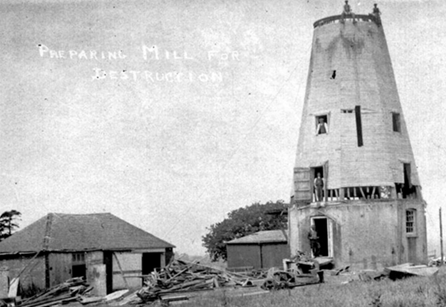
This photograph shows the mill being prepared for demolition. “The schoolchildren were allowed out of lessons to watch. It was quite an event and many villagers helped with the task. Jean Farmer recalls that her grandfather, Mr Harmer, brought home a section of one of the sails and that, for many years, her grandmother placed it across two chairs and used it as an ironing board”
 Dallington History