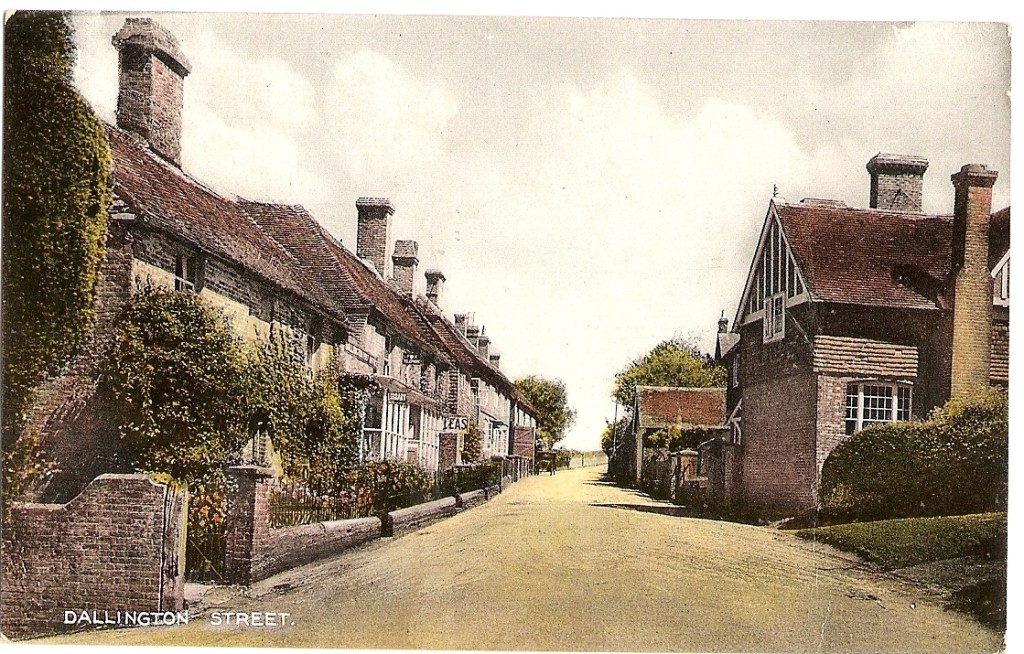
Photo: old postcard showing Dallington Street looking north from the top of Prinkle Lane outside the Old Manor.
According to local historian Jenny Stiles, The Street was not the original settlement hub in Iron Age and Roman times. The early iron works at Cinder Hill are connected by road to Ashburnham and on to Boreham Bridge, but there is no direct road from Cinder Hill up to what is now the centre of Dallington village. In the Domesday Book Dallington is a very small village (total population: 2households) and half wooded. Brightling and Ashburnham are bigger and both had a church while there is no mention of one in Dallington. A church appears in the records some hundred years later when Dallington Church was given to the Priory of Holy Trinity Hastings by Emma de Germanville, “with all its appendages except for the house of Robert the priest while he lived”. She gave this in return for various spiritual benefits including daily mass.
For insights into the subsequent development of Dallington Street, and the construction history of the medieval and later houses, see the Dallington chapters of D. & B. Martin Medieval Villages in the Eastern Weald 1250-1750 Vols 1and 2 [MVEHW 1& 2].
See also “A walk down The Street” handout produced for a visit by Uckfield U3A Local History Group 2023 for a brief introduction to some of the historic houses in The Street https://dallingtonhistory.uk/wp-content/uploads/2023/09/a-walk-down-the-street-u3a-1.pdf
Below is a list of buildings in The Street under their modern names, running broadly south on both sides of The Street from Rowlands Cottage to The Old Manor House and then down Prinkle Lane.
- Rowlands Cottage
- Carrick House (formerly Beechlands)
- (Site of former Dallington Windmill)
- Dallington CE primary school
- Pantons & Pantons Coach House
- Old School (now Village Hall)
- Hillside
- Mole Cottage (formerly Mount Pleasant)
- Bay Tree Cottage
- Staces
- Pantons Cottage
- Frog House
- Bear House
- Brookfield House
- Rokesley
- Thrums
- Old Post Office
- Clematis Cottage
- Martlets
- White House
- White Cottage
- Rose Cottage
- St Giles Church
- Old Church Cottage
- Rectory (set back from street down lane between Old Church Cottage and Old Manor)
- Yew Arch (formerly Tuttys)
- Old Manor House
- Prinkle
- Old Castle
 Dallington History