SANDS

SANDS Information from family history website http://sandh.me.uk/ssx1867/dallington1867.html

JOHN SANDS was born in 1703 in Dallington, Sussex (source : Lee Jacobs and Philip Thompson). He was baptised on 21st January 1703 in Dallington,Sussex (source : Lee Jacobs and Philip Thompson). He married MARY VALENCE on 18th January 1727/8 in Warbleton, Sussex (source : IGI, Batch No.: M042841 Dates: 1559 – 1812 Source Call No.: 0504418 Type: Film Printout Call No.: NONE Type: Sheet: 00 ). She was born in Warbleton, Sussex (source : Philip Thompson).
JOHN SANDS was born circa 1740, to JOHN SANDS and MARY SANDS nee VALENCE? (source : Joanne Mays Becker ). He was baptised on 9th December 1733 in Warbleton, Sussex (source : Joanne Mays Becker). He was a farmer (source : Joanne Mays Becker). He married ELIZABETH MARTIN on 5th February 1760 in Mountfield, Sussex (source : Keith Sands). The witnesses were Jeremiah Shadwell and William Sands. She was born circa 1738 in Mountfield, Sussex (source : burial entry). Her parents were WILLIAM MARTIN and KATHERINE CATT and she was christened on 21st November 1738 in Mountfield, Sussex (source : IGI, no source available).

JOHN SANDS (and/or his son JOHN SANDS?) appear to have rented the Manor House, Dallington, from the Earl of Ashburnham, from 1772 to 1816. In 1785 the rental was 1 pound-10 per annum. ” The building, which is a three-bay hall house, dates from the late fourteenth or fifteenth century. Whilst it is not impossible that this building was once the manor house of Dallington, its size suggests that it is more likely to have been the seat of the local manorial court … The house was known as Manor House or The Manor, while the farmland, which lay to the south and east of the property, was known as Acelands Farm or sometimes Manor Farm” (source : “Dallington, Six Miles from Everywhere, the History of a Sussex Village” by Karen Bryant-Mole). The house stayed in the family until 1851, rented by James Sands (John Sands Jr�s son) (source : Joanne Mays Becker and Keith Sands).

ELIZABETH SANDS nee MARTIN died on 20th June 1787, just three months after her son John�s marriage to Anne, and was buried in Dallington, St Giles, stone number 31 (source : SFHG Tombstone Inscription). The inscription reads : � SANDS, ELIZABETH, wife of JOHN SANDS, 20/6/1787 aged 48�, so JOHN SANDS was still alive in 1787. The Bishop’s Transcripts record a burial on 6th January 1787 for the “wife of John Sands sen.” . John senior was possibly buried on 8th April 1812 in Dallington, but as no age is given, this may not be him (source : Joanne Mays Becker).

The Children of JOHN SANDS and ELIZABETH MARTIN:

JOHN SANDS was born circa 1757. He was christened on 30th November 1760 in Dallington, Sussex (source : Dallington Parish Register).
MARY SANDS was born circa 1765. She was christened on 28th July 1765 in Mountfield, Sussex (source : Keith Sands). She died on 12th January 1793 in Dallington, Sussex, aged 27 (source : SFHG tombstones and burials index). She was buried on 16th January 1793 in Dallington, Sussex (source :Keith Sands). Her tombstone (number 30 in St Giles, Dallington, Sussex) reads : ” SANDS, MARY, died 12/1/1793, aged 27″ (source : SFHG tombstones and burials index).
SIVIER/SIVYER

I’ve collated here a number of older messages regarding the Sivyer family. If you have any more information or questions please use the Reply box below

August 13, 2009 | Linda Sivyer   “I live in Australia and we have traced our Sivyer ancestors back to Dallington with confirmation of this to around 1660s to a John Sivyer. I visited Dallington in 2007 and went to the church yard/cemetery but the old graves were too difficult to read. Is there any possibility of receiving a list of names buried in the church yard? I would appreciate any help that you could give.  We have proof back to William Sivyer born 17-7-1757 at Salehurst who married Elizabeth Burtt on 26 June 1786. William Sivyer died in 1838 at Cranbrook. From William’s parents back, we have names and dates but no proof of anything. What we have is:

  • JOHN SIVIER born 1661 at Dallington married Elizabeth YORK born 1661 at Dallington. They were married on 23 October 1688. John and Elizabeth had 5 children, youngest of whom was Francis born 3.12.1702 at Dallington..
  • Francis SIVIER married Sarah FORSTER on 28 October 1731 at Salehurst . They had 7 children of whom William born 17-7-1757 at Salehurst is the youngest and so we go down from there. We know that there were Sivyer (Sivier)s at Dallington from the Hearth Tax Records. So, if anyone knows of how we can go back further, it would be great. My father has researched and paid people in the UK to do research for him for over 40 years and now, this is as far back as we can go. What a steep little hill it is to the church yard at Dallington. I will send you separately a photo taken of me standing below the clock.”

Reply from Douglas Sewell on August 18, 2009:  “Regarding the Sivyer(Sivier) enquiry I am working on a updated version of the burial list for both the churchyard and the cemetery. If I can identify the name I will let you know….Douglas.”

April 19, 2010 | David Edgerton: “I also live in Australia (Brisbane) and my mother was also a decendent of William Sivyer and Elizabeth Burt. I found a site which traced the Australian Sivyer’s back to the Grandparents of Willian. http://www.fairhall.id.au/families/myline/desc-021880.htm According to the site Willams parents were John Sivyer (born Dallington 1661) and Elizabeth York. John’s parents were John Sivyer and Martha Rolfe. I am visiting the UK in Sept 2010 and am also hoping to find more history about the Sivyers.”

From Holly Schuetz on April 21, 2010:  “Hi..I’m from US. My ancestor, David Sivyer immigrated to US from Kent, England. According to his marriage record, his parents were Francis Sivyer & Sarah Poile of Kent, England. I know my Sivyers go way back to 1660′s, but would like to document the births, marriages of Sivyers in Dallington. Where can I write to look at parish christening records?
Would like to know more about my Sivyers. My gg grandmother was Sarah Jane aka Jeannie/Jeanette Sivyer – daughter of David Sivyer and Philomena Brunette. Thank you. Sincerely, Holly”

June 22, 2010 /jackie “hi, i just wondered if any of you have come across in y research,a francis sivier c1790,married a mary ann davies 1812 alfriston sussex?have drawn a complete blank on him, sivier is my mum paternal line, jackie”

From Christine Colbourne on August 13, 2010: “Hi – I am doing a One Name Study on SIVIER/SIVYER and have done quite a bit of research on the Sussex Siviers. The marriage of John Sivier and Martha Rolfe does not appear on the Sussex Marriage Index but there is the one reference to the couple on the Dallington baptism registers as the parents of Thomas Sivier baptised 9 Mar 1664. There is also a baptism on 5th Jan 1661 for a John Sivier – son of John Sivier. It is this John Sivier that people are assume married Elizabeth York 23 Oct 1688 in Dallington. However – if you check the burial registers for Dallington you find that John Sivier son of John Sivier died in 1669 and was buried there on the 18th May. Hence he cannot be the John who married Elizabeth York. Looking at wills of the time which mention John Sivier of Dallington it would appear he was a son of Stephen Sivier who married Elino r/Helen Lymberhurst at Sedlescombe in 1658.
Christine Colbourne – member of the guild of One Name Studies rersearching SIVIER/SIVYER/SIVERS/SIVER

From Trevor Sivyer sivyert@aol.com August 31, 2011: “it is very interesting reading your comments about the sivyer family.my name is trevor sivyer and i live in hastings in east sussex,england. my brother graham and mother still live locally as do most of our children. many years ago my grandfather(robert sivyer) which was also my fathers name traced back many 100s of years and most of our relatives were in the mayfield/east hoathly areas of east sussex,these places are not far from dallington.”


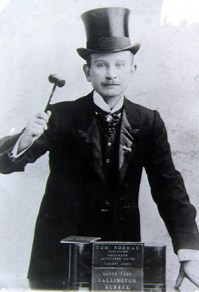
Thomas Noakes aka Tom Norman, fairground showman

Photo of Tom Norman/Noakes
Photograph of Tom Norman c.1900 (Norman Family Collection, National Fairground Archive)

You might not associate Dallington with the so-called  freak shows of Victorian London, but the story of Thomas Noakes, aka Tom Norman, showman and auctioneer,  shines a fascinating light on popular entertainment at the end of the 19th century.

Thomas was born in Dallington in 1860, the eldest son of a butcher, also Thomas Noakes, whose business was based at the Old Manor in The Street. According to his autobiography, young Thomas was a bit of a tearaway, managing to alienate his father’s wealthiest customer by courting his daughter, and he left home while still in his teens intending “to seek fame and fortune on the road ”.  He then lost all his savings in two days of gambling at Ascot racecourse, but his fortunes changed when he realised there was better money to be made in the showman’s shops which at this time exhibited freaks and novelties to the public.

Tom, who at some point in this period changed his name to Norman (possibly to avoid embarrassment to his family),  said later “You could indeed exhibit anything in those days. Yes anything from a needle to an anchor, a flea to an elephant, a bloater you could exhibit as a whale. It was not the show; it was the tale that you told.”

And Tom was very good at telling tales, using his gift for patter to drum up audiences for the s ‘penny gaffs’ – small shops and front rooms, often illegally occupied rent free over a weekend, where audiences crowded the streets outside before being persuaded to hand over a penny to see human novelty acts such as bearded ladies, midgets, Mlle Electra the Electric Lady and many others. Nowadays it seems distasteful (to say the least) to display human beings in this way, but Norman and other showmen argued forcefully that this was one of the few ways in which disabled people could earn a decent living rather than being  confined to the workhouse.

Indeed Tom’s most notorious  ‘act’ – Joseph Merrick, the so-called Elephant Man – was not just a willing participant, but had decided to exhibit himself publicly for a share of the profits as a way to escape the Leicestershire workhouse where he had lived before.  He wrote “In making my first appearance before the public, who have treated me well — in fact I may say I am as comfortable now as I was uncomfortable before.” The film The Elephant Man, based on the memoir by Frederick Treves, the doctor who removed Merrick from the show circuit, portrayed  Norman as a ruthless exploiter, but recent scholarship has contradicted this. In fact, Merrick apparently resented the medical examinations by Treves and his medical students, saying that they made him feel “like an animal in a cattle market”

Norman liked to see himself as the English equivalent to PT Barnum, the American circus proprietor. He often announced to his audiences that his show had been booked to appear at Barnum’s ‘Greatest Show on Earth’. One time he did so, Barnum himself was in the audience, but fortunately saw the funny side. Meeting Norman after the show, amused by Norman’s enormous silver medallions and noting his gift for oratory, Barnum nicknamed him the ‘Silver King’

Throughout the 1880s and 1890s,  Tom continued to manage multiple shops, shows and travelling exhibits with perfomers including Mary Anne Bevan the World’s Ugliest Woman, John Chambers the Armless Carpenter and Leonine the Lion Faced Lady, and later early cinema shows.

He  eventually switched to work as an auctioneer, specialising in travelling shows and circus effects, and presumably using his gift of oratory to sell the goods –  and at some point he based his auctioneering business back where he began at the Old Manor in Dallington.

You can find more information about Thomas Noakes in an article by Vanessa Toulmin for the National Fairground and Circus Archive

http://www.nfa.dept.shef.ac.uk/history/shows/norman.html

There is also a Wikipedia entry with more references at https://en.wikipedia.org/wiki/Tom_Norman

Hot air balloon landing in 1935?

My name is Sheena Griffin and my grandfather Charles Young owned a farm in Dallington in 1934/35. My father tells a story of a hot air balloon landing on his fathers farm around that time with 3 Belgium men aboard. We are trying to investigate this happening and would be grateful is anyone can elaborate.
Apparently the Sussex Express sent a reporter and pictures where taken, I believe even the local school children visited the farm the next day to see the balloon.

Regards

Sheena

CLARK,SUTTON and NIGHTINGALE families

CLARK,SUTTON and NIGHTINGALE families in Dallington and Brightling 1830 onwards

[The account below was kindly supplied by Maureen Hague and posted on her behalf]

In 1839 my great great grandfather William Frederick Clark was Miller at Coxes Mill Dallington working in partnership with Albert Geering. In June 1858 it seems that it is the Geering family living at Coxes Mill. Albert Geering had married Williams sister in law Rebecca Sutton (daughter of Samuel and Elizabeth Sutton).

Just down the road from Coxes Mill was Dabchicks occupied by Rebecca’s brother. William was married to Elizabeth , Rebecca’s sister. Rebecca died in 1864 and her death ,plus the death of Williams wife Elizabeth on Christmas day 1863 , and the death of Williams son George caused the death of Elizabeth Sutton the mother of the 2 girls and grandmother of George.

George Clark was born in 1839 and lost his life in tragic circumstances at Coxes Mill in March 1864. On the night of Thursday 17th March George was working at Coxes Mill with his younger brother Charles and his father William when his Millers frock became entangled in machinery. He received mortal fractures to the left leg and a fracture to the right. On the coroner’s report it states that he languished for 2 days having had a leg amputated. He is buried in the church in Brightling with his mother Elizabeth.  Rebecca was buried in St Giles Dallington.

On the 18th day of May 1864 Elizabeth Sutton, mother and grandmother took her own life by cutting her throat. This took place at Prinkle Farm Dallington where the Suttons lived.IN the coroners report it states she was not of sound mind.

Samuel Sutton died July14th 1880 and is buried in Dallington St Giles . The Suttons had quite a few children who stayed in the area.

Charles Frederick Clark ,my greatgrandfather married Jane Nightingale on 17th October 1867. Her father was John Nightingale , a farmer having lands around Haseldean and Giffords Farm. By 1871 the Clarks and Nightingales move to Heath Mill Pulborough where after 4 children Jane dies. Charles remarries and returns to work with his father for a while at Darwell Mill ,near Brightling,He has a further 10 children.five being born in Brightling.William Clark ,who marries his first love Naomi Jarman in 1866 dies in 1876 and is buried in Brightling. Before his marriage to Elizabeth Sutton William had a son William in 1837 by Naomi Jarman.

I myself was evacuated as a young child to Great Worg Farm Brightling which does not seem far from Coxes Mill. My grandmother, |Emma Julia, youngest daughter of Charles and Jane ,b 1872 in Pulborough died there in 1941.