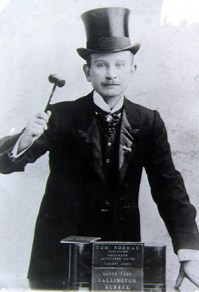
You might not associate Dallington with the so-called freak shows of Victorian London, but the story of Thomas Noakes, aka Tom Norman, showman and auctioneer, shines a fascinating light on popular entertainment at the end of the 19th century.
Thomas was born in Dallington in 1860, the eldest son of a butcher, also Thomas Noakes, whose business was based at the Old Manor in The Street. According to his autobiography, young Thomas was a bit of a tearaway, managing to alienate his father’s wealthiest customer by courting his daughter, and he left home while still in his teens intending “to seek fame and fortune on the road ”. He then lost all his savings in two days of gambling at Ascot racecourse, but his fortunes changed when he realised there was better money to be made in the showman’s shops which at this time exhibited freaks and novelties to the public.
Tom, who at some point in this period changed his name to Norman (possibly to avoid embarrassment to his family), said later “You could indeed exhibit anything in those days. Yes anything from a needle to an anchor, a flea to an elephant, a bloater you could exhibit as a whale. It was not the show; it was the tale that you told.”
And Tom was very good at telling tales, using his gift for patter to drum up audiences for the s ‘penny gaffs’ – small shops and front rooms, often illegally occupied rent free over a weekend, where audiences crowded the streets outside before being persuaded to hand over a penny to see human novelty acts such as bearded ladies, midgets, Mlle Electra the Electric Lady and many others. Nowadays it seems distasteful (to say the least) to display human beings in this way, but Norman and other showmen argued forcefully that this was one of the few ways in which disabled people could earn a decent living rather than being confined to the workhouse.
Indeed Tom’s most notorious ‘act’ – Joseph Merrick, the so-called Elephant Man – was not just a willing participant, but had decided to exhibit himself publicly for a share of the profits as a way to escape the Leicestershire workhouse where he had lived before. He wrote “In making my first appearance before the public, who have treated me well — in fact I may say I am as comfortable now as I was uncomfortable before.” The film The Elephant Man, based on the memoir by Frederick Treves, the doctor who removed Merrick from the show circuit, portrayed Norman as a ruthless exploiter, but recent scholarship has contradicted this. In fact, Merrick apparently resented the medical examinations by Treves and his medical students, saying that they made him feel “like an animal in a cattle market”
Norman liked to see himself as the English equivalent to PT Barnum, the American circus proprietor. He often announced to his audiences that his show had been booked to appear at Barnum’s ‘Greatest Show on Earth’. One time he did so, Barnum himself was in the audience, but fortunately saw the funny side. Meeting Norman after the show, amused by Norman’s enormous silver medallions and noting his gift for oratory, Barnum nicknamed him the ‘Silver King’
Throughout the 1880s and 1890s, Tom continued to manage multiple shops, shows and travelling exhibits with perfomers including Mary Anne Bevan the World’s Ugliest Woman, John Chambers the Armless Carpenter and Leonine the Lion Faced Lady, and later early cinema shows.
He eventually switched to work as an auctioneer, specialising in travelling shows and circus effects, and presumably using his gift of oratory to sell the goods – and at some point he based his auctioneering business back where he began at the Old Manor in Dallington.
You can find more information about Thomas Noakes in an article by Vanessa Toulmin for the National Fairground and Circus Archive
http://www.nfa.dept.shef.ac.uk/history/shows/norman.html
There is also a Wikipedia entry with more references at https://en.wikipedia.org/wiki/Tom_Norman
 Dallington History